
Pterygium
Also known as: Surfer’s eye
Overview
A pterygium is a wing-shaped fibrovascular growth of conjunctival tissue that extends onto the cornea, strongly associated with chronic ultraviolet light and environmental exposure. It can cause irritation, redness, induced astigmatism, and, when it encroaches on the visual axis, reduced vision. Management ranges from ocular surface support to surgical excision with conjunctival autografting to lower recurrence.
- Nature
- Fibrovascular growth onto cornea
- Major risk factor
- Ultraviolet / environmental exposure
- Visual impact
- Induced astigmatism, axis encroachment
- Definitive care
- Excision with conjunctival autograft
Key clinical points
- Chronic UV exposure is the principal risk factor; sun protection is preventive.
- Many pterygia are asymptomatic and can be observed.
- Growth toward the visual axis can induce astigmatism and blur.
- Surgical excision with conjunctival autograft has lower recurrence than bare-sclera techniques.
- A pterygium must be distinguished from ocular surface neoplasia when atypical.
Presentation
A pterygium typically appears as a fleshy, triangular growth extending from the nasal (or less often temporal) conjunctiva onto the cornea. Symptoms include redness, foreign body sensation, dryness, and cosmetic concern. As it advances, it can flatten the cornea and induce astigmatism, and involvement of the visual axis reduces vision.
A pinguecula is a related, earlier conjunctival lesion that has not crossed onto the cornea.
Evaluation
Examination documents the size, vascularity, and extent of corneal encroachment, and corneal topography quantifies induced astigmatism. Atypical, rapidly growing, or leukoplakic lesions should raise suspicion for ocular surface squamous neoplasia and prompt appropriate evaluation.
Management
Asymptomatic pterygia are observed with sun protection and ocular surface support such as lubrication. Surgery is indicated for significant irritation, cosmetic concern, growth threatening the visual axis, or documented induced astigmatism. Excision with conjunctival or limbal-conjunctival autograft substantially reduces recurrence compared with bare-sclera excision, and adjuncts are used in select cases.
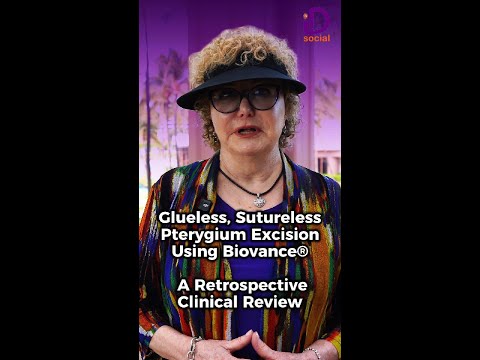
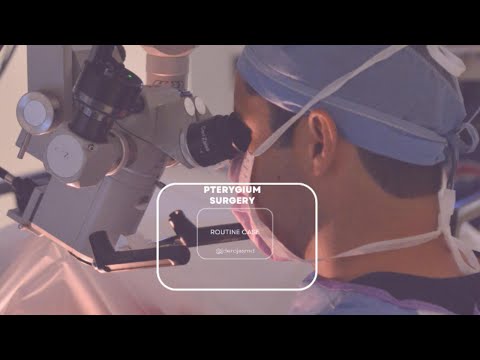
Pterygium videos

Frequently asked questions
- What causes a pterygium?
- Chronic exposure to ultraviolet light and environmental factors such as wind and dust is the principal cause, which is why pterygia are more common in sunny climates and outdoor occupations and why sun protection is preventive.
- When does a pterygium need surgery?
- Surgery is considered for persistent irritation, cosmetic concern, induced astigmatism, or growth threatening the visual axis. Excision with a conjunctival autograft is preferred because it lowers the recurrence rate.
- What is the difference between a pterygium and a pinguecula?
- A pinguecula is a conjunctival deposit that does not extend onto the cornea, while a pterygium is a fibrovascular growth that crosses onto the corneal surface and can affect vision.
References & further reading
Related conditions
Dry Eye Disease
Dry eye disease is a multifactorial disease of the ocular surface characterized by loss of tear film homeostasis, accompanied by ocular symptoms, in which tear film instability, hyperosmolarity, inflammation, and neurosensory abnormalities play etiological roles. It is among the most common reasons patients present to eyecare providers. Management is staged and targets the underlying subtype—aqueous-deficient, evaporative, or mixed.
Clinical overviewCataract & RefractiveAstigmatism
Astigmatism is a refractive error in which the cornea or lens has unequal curvature across meridians, so light focuses at multiple points rather than one, blurring vision at all distances. Regular astigmatism is correctable with cylindrical lenses, while irregular astigmatism—often from corneal disease—requires specialty contact lenses. It commonly coexists with myopia or hyperopia.
Clinical overview